
What Became of the Dream
The tale of Bill Smith and the reshaping of a city after the timber industry left town.
Written by Tim Neville
One evening last summer, as the sunset turned the sky the color of strawberries, some friends and I were floating the Deschutes River through the Old Mill District. Cattails swayed as red-winged blackbirds sang. Couples strolled along the grassy banks. Not so long ago, this same stretch of river looked and sounded nothing like it does today.
In March 1916, the Shevlin-Hixon Lumber Co. fired up on the west bank of the Deschutes, where an 800-horsepower engine drove two band saws larger than anything used back east. The mill walls were tidy and white, and electric lights hummed overhead. A month later, a rival mill opened across the river: Brooks-Scanlon. Together, they would produce enough lumber to frame roughly 60 homes a day.
“The dream, Bend, the sawmill and lumber center of Central Oregon, is now an actuality,” declared a front-page article in The Bulletin.
 For nearly eight decades, the mills were Bend’s economy. When the whistles blew, the town moved with them. Workers filed out of 10-hour shifts with $2.75 in their pocket, roughly $85 today. They bought groceries at Gilbert & Sons, meals at Nettie Stevenson’s Little Brick Restaurant, and new Balbriggan underwear at R.M. Smith. Bend was rolling in it. “The employees will, no doubt, be called upon frequently to make contributions to the community,” wrote mill superintendent T.A. McAnn.
But that boom came at a cost. Logs choked the river. Oils seeped into the soil. In places, sawdust piled so deep it buried the shoreline and coated the riverbed.
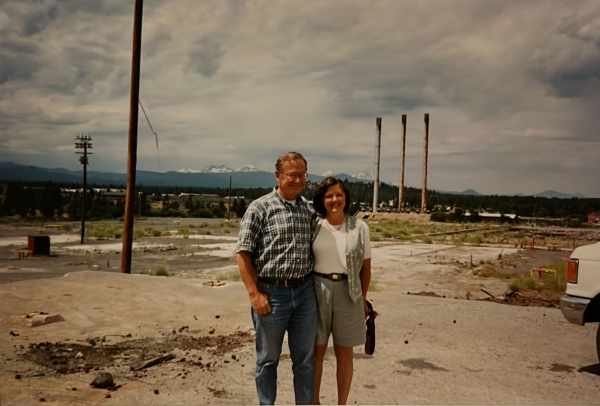
As the century wore on the economy began to unravel. Shevlin-Hixon’s timber supply dwindled and in 1950 the company sold to Brooks-Scanlon. Markets softened. Mills across the West shut down. In 1980, Brooks-Scanlon sold, production slowed, then stopped. By the mid-1990s, the mills had gone quiet. Bend, once thriving, faced collapse.
“It was kind of like a World War II zone,” says longtime Bend resident Jim Crowell, who worked for Brooks-Scanlon. The river, once central to the mills’ success, had become something to avoid. “You just didn’t get in at all,” says Marney Smith, who grew up in Bend. “It would have been suicide.”
That would all change.
Bill Smith, Marney’s father, arrived in Bend in 1969 with an MBA from Stanford and a job at Brooks-Scanlon. Tasked with finding new revenue streams, he quickly saw that the company’s vast land holdings might be more valuable as places to live than timber to cut. A spin-off, Brooks Resources, was born. “Bill could see ten dots ahead,” says Mike Hollern, who hired him. “He was incredibly bright.”
In the early 1970s, during a labor strike, Smith worked as a night watchman and walked the mill grounds after dark. Somewhere between the log piles and glowing burners, he saw something different. The Deschutes River, long treated as a workhorse, could be the center of something new, maybe a riverfront that welcomed people instead of shutting them out.

“Bill always wanted to build a place where his kids wanted to come back and live,” Marney Smith says. “He wanted a place that was safe, that was additive.”
The idea lingered for years. Then, in 1993, Smith got his chance.
By then, Smith had formed William Smith Properties, Inc. The mill site—nearly 300 acres of riverfront—was defunct but prime. With six investors, Smith assembled a deal to purchase 270 acres along both sides of the river, a bold bet on land most people saw as worthless.
“I was off doing my own thing, but I knew something was making him really nervous,” Marney Smith says. “He was chain-smoking a lot of cigarettes.”
“Bill was rolling the dice,” adds Kelly Cannon-Miller, executive director of the Deschutes County Historical Society. “Ultimately the shift he was going for where the mills stood would mirror the shift in the entire community—away from an industrial, natural-resource based economy to a place where trees are still a resource but for camping and hiking and being outside.”
Smith understood the scale of what he’d taken on and then matched it with a tireless work ethic. Rather than wait for public funding, he and his partners undertook the cleanup themselves. Crews removed contaminated soil. Others excavated sawdust layers as deep as 15 feet from the riverbed. Boulders and gravel stabilized the banks. A fish ladder reopened upstream passage after 80 years.
By the late 1990s, more than 2.5 miles of riverfront had been restored and opened to the public for the first time in generations. In 2002, the project earned the Environmental Protection Agency’s Phoenix Award for a brownfield brought back from the ashes.
Twenty-five years ago this June, under a blue sky brushed with thin clouds, Smith stood before a crowd of thousands and cut a ribbon with his pocketknife. The Old Mill District was open.
What began with 15 tenants now draws more than 3 million visitors a year. Shops and restaurants line paths where rail spurs once ran. The river that carried logs now carries kayakers, paddleboarders, and costumed floaters during holiday events. Across the water, music fills the air at the amphitheater.
That evening last summer, we eventually climbed out of the river. I walked back toward the put-in along a trail lined with memorials to the people who shaped this town. We met for a beer, shorts still wet, and sat outside as the light faded. And above it all loomed the smokestacks and a river sluicing by them.


Leave A Comment